Semen Production in the Quran: Difference between revisions
| [checked revision] | [checked revision] |
Lightyears (talk | contribs) |
Lightyears (talk | contribs) (Automated script replacing USC-MSA hadith numbering system for Bukhari, Muslim, and Abu Dawud) |
||
| (One intermediate revision by the same user not shown) | |||
| Line 57: | Line 57: | ||
One other verse in the Qur'an uses the word ''sulb''. In this case there is no mention of ''tara'ib''. It is an example of the simple Arabic phrase mentioned in Lane's Lexicon (see above), based on the belief that the seed of men proceed from their backs.{{Quote|{{Quran|4|23}}|'''Sahih International:''' Prohibited to you [for marriage] are your mothers, your daughters, your sisters [...] the wives of your sons who are from your [own] loins, and that you take [in marriage] two sisters simultaneously, except for what has already occurred. Indeed, Allah is ever Forgiving and Merciful}} | One other verse in the Qur'an uses the word ''sulb''. In this case there is no mention of ''tara'ib''. It is an example of the simple Arabic phrase mentioned in Lane's Lexicon (see above), based on the belief that the seed of men proceed from their backs.{{Quote|{{Quran|4|23}}|'''Sahih International:''' Prohibited to you [for marriage] are your mothers, your daughters, your sisters [...] the wives of your sons who are from your [own] loins, and that you take [in marriage] two sisters simultaneously, except for what has already occurred. Indeed, Allah is ever Forgiving and Merciful}} | ||
Slightly more explicitly, a hadith in [[Sahih Bukhari]] (also in {{Muslim| | Slightly more explicitly, a hadith in [[Sahih Bukhari]] (also in {{Muslim||2805a|reference}}) uses ''sulb'' to say that the source of Adam's future progeny was in his back from before they were conceived. | ||
{{Quote|{{Bukhari| | {{Quote|{{Bukhari|||6557|darussalam}}|The Prophet (pbuh) said, "Allah will say to the person who will have the minimum punishment in the Fire on the Day of Resurrection, 'If you had things equal to whatever is on the earth, would you ransom yourself (from the punishment) with it?' He will reply, Yes. Allah will say, 'I asked you a much easier thing than this while you were in the backbone of Adam, that is, not to worship others besides Me, but you refused and insisted to worship others besides Me."'}} | ||
This concept did not just apply to Adam. Another hadith confirms that ''sulb'' refers in this way even to the backbone of a specific man's father. | This concept did not just apply to Adam. Another hadith confirms that ''sulb'' refers in this way even to the backbone of a specific man's father. | ||
| Line 140: | Line 140: | ||
While the verb yakhruju (he/it comes forth) has a quite general meaning in the Quran, critics note that it is used in {{Quran|16|69}} in relation to honey coming forth from the bellies of bees, and in {{Quran|2|74}} in relation to rivers coming forth from rocks. | While the verb yakhruju (he/it comes forth) has a quite general meaning in the Quran, critics note that it is used in {{Quran|16|69}} in relation to honey coming forth from the bellies of bees, and in {{Quran|2|74}} in relation to rivers coming forth from rocks. | ||
Critics of the childbirth interpretation further note that it is helpful to look at the verses in their immediate context, where the topic is the humble substance from which man is created, and with such power Allah will also be able to resurrect him. | Critics of the childbirth interpretation further note that it is helpful to look at the verses in their immediate context, where the topic is the humble substance from which man is created, and with such power Allah will also be able to resurrect him. The same sequence occurs in {{Quran-range|80|18|22}} for comparison. | ||
{{Quote|{{Quran-range|86|5|8}}|5 So let man observe '''from what''' he was created.<BR /> | {{Quote|{{Quran-range|86|5|8}}|5 So let man observe '''from what''' he was created.<BR /> | ||
| Line 147: | Line 147: | ||
8 Indeed, Allah, to return him [to life], is Able.}} | 8 Indeed, Allah, to return him [to life], is Able.}} | ||
Moreover, there is no thumma or fa (both meaning "then") between verses 6 and 7, unlike other verses describing stages of conception through to birth. Therefore, these two verses seem to describe a single process. | Moreover, there is no thumma or fa (both meaning "then") between verses 6 and 7, unlike all other verses describing stages of conception through to birth ({{Quran|18|37}}, {{Quran|22|5}}, {{Quran|35|11}}, {{Quran|40|67}}, {{Quran-range|23|13|14}}, and {{Quran-range|75|37|39}}). Therefore, these two verses seem to describe a single process. | ||
Critics further note that the womb and fetus during pregnancy and childbirth are obviously not located within the mother's ribcage | Critics further note that the womb and fetus during pregnancy and childbirth are obviously not located within the mother's ribcage. Therefore it is not plausible that the author would describe a newborn child as coming forth from between a woman's backbone and ribs. | ||
===Muhammad Asad - loins and pelvic arch=== | ===Muhammad Asad - loins and pelvic arch=== | ||
{{Quote||(5) LET MAN, then, observe out of what he has been created:<br>(6) he has been created out of a seminal fluid<br>(7) issuing from between the loins [of man] and the pelvic arch [of woman].<br> | {{Quote||(5) LET MAN, then, observe out of what he has been created:<br>(6) he has been created out of a seminal fluid<br>(7) issuing from between the loins [of man] and the pelvic arch [of woman].<br> | ||
Latest revision as of 00:24, 15 November 2025

| This article or section is being renovated. Lead = 4 / 4
Structure = 4 / 4
Content = 4 / 4
Language = 4 / 4
References = 3 / 4
|

Towards the end of the 20th century and into the early 21st century, drawing on the work of a broad and largely Saudi-financed movement to demonstrate the concordance of Islamic scriptures and modern science, attempts have been made to defend the Qur'anic idea of semen production (found in Quran 86:6-7) from between the sulb (literally "backbone"[1]) and the tara’ib (literally "ribs"[2]). Several specific interpretations have been proposed, critiqued, and withdrawn by modern Islamic scholars - none, however, have been welcomed by the professional scientific or historian community.
The most common of these revisionary perspectives which advocate an interpretation of the Quran via its reconciliation with modern science include that of Drs. Maurice Bucaille and A. K. Giraud (according to which sulb and tara’ib refer to the sexual areas of the male and female); Ahmed A. Abd-Allah (according to which all acknowledged translations and tafsirs are in error, as sulb and tara’ib refer instead to to the male's “hardening” penis and the female's erogenous zones other than the vagina); Dr. Zakir Naik (according to which sulb and tara’ib refer to the backbone and ribs of both sexes and where the blood, nerve and lymphatic supply to the gonads are being described rather than the act of sexual reproduction); Dr. Jamal Badawi (according to which the verses refer not to semen production but to the blood of the aorta as the ‘gushing fluid poured forth’); Hamza Tzortzis (according to whom the Quran refers to childbirth from between a woman's backbone and ribs); Muhammad Asad (according to which sulb refers to the male's loins and tara'ib to the female's pelvic arch); Moiz Amjad (who adopts Naik's positions, and further claims that the sulb and tara'ib 'region' alluded to are special euphemisms for the sexual organs); and Yusuf Ali (according to which the backbone is only symbolically alluded to as a symbol of male strength where semen flows between the backbone and ribs).
Semen production in Islamic scriptures
Verses 86:6-7
There is relatively little disagreement over the proper translation of Quran 86:6. The only recurrent disagreement between translations is over whether the word maa should be translated literally as 'water' or generalized to 'fluid'. Most translations opt for the former translation, which is accurate to the Arabic text, as opposed to the latter, which amounts to a metaphorical interpretation. No scholar has expressed disagreement with the fact that the word for water (maa) was the standard Arabic euphemism for 'semen' - many translations have included this point in their footnotes on the verse.
Corpus.quran.com translation (literal): He is created from a water [maa, the word 'water' was the standard Arabic euphemism for semen], ejected,
Transliteration: Khuliqa min main dafiqin
As can be seen in the competing translations listed below, there is significant disagreement among Islamic translations and controversy surrounding the translation of the subsequent verse, Quran 86:7.
Corpus.quran.com translation (literal): Coming forth from between the backbone and the ribs.
Transliteration: Yakhruju min bayni alssulbi waalttara-ibi
Pickthal: that issued from between the loins and ribs.
Sahih International: Emerging from between the backbone and the ribs.
Arberry: issuing between the loins and the breast-bones.
Shakir: coming from between the back and the ribs.
Sarwar: which comes out of the loins and ribs.
Khalifa: from between the spine and the viscera.
Hilali/Khan: proceeding from between the back-bone and the ribs.
Malik: that is produced from between the loins and the ribs.
Maulana Ali: coming from between the back and the ribs.
Free Minds: it comes out from between the spine and the testicles.The word sulb, translated as 'loins'
Many Islamic translations opt to translate the word sulb in Quran 86:7 as 'loins', which can lead English speakers to read it in the euphemistic sense of the word 'loins', alluding to the reproductive organs of a male. However, this sense of the English word 'loins' is secondary to its primary sense, which refers to the lumber portion of the back (hence the word sirloin, which refers to '(a piece of) meat from the back of an animal near the tail or from the top part of the back legs').[3] Both senses of the word are accounted for in the Oxford English Dictionary.
1. a. In the living body. Chiefly pl. The part or parts of a human being or quadruped, situated on both sides of the vertebral column, between the false ribs and the hip-bone.
2. Chiefly Biblical and poet. This part of the body, regarded: a. as the part of the body that should be covered with clothing and about which the clothes are bound; so, to gird (up) the loins (lit. and fig.), to prepare for strenuous exertion.
This ambiguity in some English translations of sulb as 'loins' is sometimes exploited by modern da'ees attempting to reconcile the verse with modern science.
Clarity on the matter is found in the authoritative Lane's Lexicon of Classical Arabic, whose definition for sulb involves the English word loins clearly in its primary, literal sense relating to the back:
Lane also quotes an Arab saying that features sulb, translating and explaining it as follows (sperma is a Late Latin word meaning seed, or semen):
Supporting evidence in other verses and hadiths
Independent corroboration that sulb in the Qur'an refers to the back or backbone is found in another verse on the same subject using a different Arabic word for back. Quran 7:172 says that the offspring of the children of Adam are 'from their backs (loins)'. Instead of sulb, the word here is thahr, which means the back[4], as is also the case in other verses such as Quran 6:31.
Arabic: مِنۢ بَنِىٓ ءَادَمَ مِن ظُهُورِهِمْ ذُرِّيَّتَهُمْ
Transliteration: min banee adama min thuhoorihim thurriyyatahumA hadith about this verse mentions Allah stroking Adam's back (thahr, like in Q 7:172, not sulb) to produce progeny.
One other verse in the Qur'an uses the word sulb. In this case there is no mention of tara'ib. It is an example of the simple Arabic phrase mentioned in Lane's Lexicon (see above), based on the belief that the seed of men proceed from their backs.
Slightly more explicitly, a hadith in Sahih Bukhari (also in Sahih Muslim 2805a) uses sulb to say that the source of Adam's future progeny was in his back from before they were conceived.
This concept did not just apply to Adam. Another hadith confirms that sulb refers in this way even to the backbone of a specific man's father.
Similar ancient ideas
Plato (d. 347 BCE) believed that semen came from brain and spinal marrow. An open access paper published by the Royal Society London observes that the idea of semen deriving from the backbone has a long history:
[...]
Plato's connection of brain and spinal marrow was an ancient one. The Hebrew word מוח and Arabic مخ share the proto-semetic etymological root *muḫḫ- meaning “head; brain; marrow”.[6][7]
Hippocrates (d. 375 BCE) around the same time taught that semen comes from all the fluid in the body, diffusing from the brain into the spinal marrow, before passing through the kidneys and via the testicles into the penis.[8]
Classical perspectives
Ibn Kathir
The idea that al sulb in Quran 86:7 refers to the backbone of the man and al tara'ib to the ribs of the woman was among the opinions included by al-Tabari in his tafsir, and became the mainstream classical view. In both cases where "the backbone" of the man is mentioned by Ibn Kathir in the quote below, the words are the "sulb" of the man in arabic.
(So, let man see from what he is created!) This is alerting man to the weakness of his origin from which he was created. The intent of it is to guide man to accept (the reality of) the Hereafter, because whoever is able to begin the creation then he is also able to repeat it in the same way. This is as Allah says,
(And He it is Who originates the creation, then He will repeat it; and this is easier for Him.) (30:27) Then Allah says,
(He is created from a water gushing forth.) meaning, the sexual fluid that comes out bursting forth from the man and the woman. Thus, the child is produced from both of them by the permission of Allah. Due to this Allah says,
(Proceeding from between the backbone and the ribs.) meaning, the backbone (or loins) of the man and the ribs of the woman, which is referring to her chest. Shabib bin Bishr reported from `Ikrimah who narrated from Ibn `Abbas that he said,
(Proceeding from between the backbone and the ribs.) "The backbone of the man and the ribs of the woman. It (the fluid) is yellow and fine in texture. The child will not be born except from both of them (i.e., their sexual fluids). Concerning Allah's statement,
(Verily, He is Able to bring him back (to life)!) This means that He is able to return this man that is created from fluid gushed forth. In other words, He is able to repeat his creation and resurrect him to the final abode. This is clearly possible, because whoever is able to begin the creation then he surely is able to repeat it. Indeed Allah has mentioned this proof in more than one place in the Qur'an.The theory that conception arises from a mixture of male and female sexual fluids (maniy) mentioned by Ibn Kathir was one of the influential teachings of the 2nd century CE Greek physician Galen, and is found also in the Talmud. These ideas are clearly apparent in a variety of hadiths, and possibly even in the Quran itself (see the article Sources of Islamic Theories of Reproduction).
Al-Jalalayn
Similarly the classical Islamic scholars, 'the two Jalal's' (composed first by Jalal ad-Din al-Maḥalli in 1459 and then completed after his death by Jalal ad-Din as-Suyuti in 1505), write in their extremely influential exegesis of the Quran.
Modern revisionary perspectives
Maurice Bucaille - sexual areas of the man and woman
"(Man was fashioned from a liquid poured out. It issued (as a result) of the conjunction of the sexual area of the man and the sexual area of the woman. [...] The sexual area of the man is indicated in the text of the Qur'an by the word sulb (singular). The sexual areas of the woman are designated in the Qur'an by the word tara'ib (plural). [...] This is the translation which appears to be most satisfactory."
Critics have pointed out that while a case can be made that sulb means “hardening” and thus, metaphorically, "penis", there is no comparable case that tara’ib can mean "vagina". Bucaille and Giraud hold that tara’ib means the ’sexual areas of the woman’ but do not provide evidence to this end save the quote produced by Bucaille above (which itself gives no justification for this reading). Critics also argue that if tara'ib does mean what Bucaille and Giraud take it to mean, 'sexual areas of the woman' is too vague and speculative an interpretation to be meaningfully accurate or constitutive of a scientific miracle.
Ahmed A. Abd-Allah - male hardening and female sexual area
Abd-Allah extends Bucaille’s interpretation, providing dictionaries and tafsirs to support his case that sulb means ‘hardening’ and tara’ib means the sexual areas of the woman. Abd-Allah defines sulb as follows:
Critics note that almost all the commonly available translations of the Qur'an refer to sulb as the backbone or loins. Even classical authorities such as Ibn Kathir accept the meaning of the word as "backbone". Additionally, Hans Wehr, a dictionary of modern standard rather than classical Arabic, is an unreliable source for determining the meanings of words in the Qur'an. Lane's Lexicon, which is a lexicon based on classical Arabic dictionaries and sources, defines sulb singular as the backbone, as noted above, and as we also see in one of the hadiths quoted above.
Critics also argue that Abd-Allah’s proposition is undercut by the definitions of tara’ib he provides. He does not show that the tafsirs and dictionaries explain tara’ib to mean vagina. Tara’ib is defined as the upper chest or ribs, or according to some sources can also mean the two legs, two arms or two eyes[2]. While erogenous zones are important in foreplay, the sexual act must be consummated through the vagina.
Finally, critics argue that Abd-Allah’s reference to Ibn Kathir’s tafsir is misleading, as it includes only the half of the description which supports his case (i.e. that tara’ib refers to the woman) and excludes the other half that contradicts it (i.e. that tara’ib is the woman’s ribs).
Zakir Naik - original location of male and female gonads
Critics argue that Zakir Naik makes a number of errors in his claims here. Firstly, Quran 8:6 does not mention a "drop emitted" but rather a water (i.e. fluid) ejected (māin dāfiqin), which was always understood to mean semen, and in the next verse is said to come forth from between the backbone and ribs.
Secondly, his interpretation of the verses to mean the embryonic development of the testes is misleading, as the verse implies a fully developed and functional reproductive system, rather than an embryonic structure. Embryonic testes do not emit, ejaculate, gush forth, pour forth, spurt or ejaculate any substance; only peri- and post-pubertal testes and associated glands do.
Naik’s explanation of the nerve, blood and lymphatic circular from the abdominal aorta is not relevant to the phenomenon being discussed. Semen is directly responsible for human reproduction, something which cannot be claimed for nerve signals, blood or lymph, or countless other anatomical features enabling a sexually active being. Circulation and nerve supply also do not correlate with embryonic origin. For example, the blood supply, lymphatics and nerve supply of the lower limbs originate in the abdomen and pelvis. This does not mean the lower limbs embryonically originated in the abdomen and pelvis.
Finally, critics note that Naik incorrectly presents the biology and location of the phenomenon he describes in a number of ways. The original position of the cells, which are destined to develop into spermatogonia (sperm producing cells) are not ventro-medial to the kidneys (where these cells develop) but the wall of the yolk sac:
The full argument of the critics runs as follows. If Naik’s assertion that the verse refers to the embryonic testes is accepted, it is not evident whether the gonads are located where he claims, i.e. between the spinal column and the eleventh and twelfth ribs. A cross-sectional diagram of the human embryo shows the gonads at or around the level of the placenta.

Consequently, it cannot be said that the embryonic testes is located between the spinal column and the eleventh and twelfth ribs as the gonadal or genital ridge (precursor of the gonads) is generally held to lie medial to the lower part of the mesonephros, while the adult kidney actually develops from the metanephros.
It is likewise incorrect to assume the position of the embryonic gonads from the position of the adult kidneys, as the embryonic positions of gonads and kidneys are not the same as their adult positions. Gonads descend, while kidneys enlarge and ascend. Also, the developing gonads are ventro-medial to the mesonephros (i.e. the embryonic kidney) and not the metanephros (which would develop into the adult kidney). Zakir Naik does not differentiate between the mesonephros and the metanephros.
If Naik’s implied association between embryonic and adult anatomical positions were accepted, the explanation given is inaccurate because in the condition of cryptorchidism where the testes is undescended, the highest position of the undescended testes is below the kidney.[9]
Additionally, the inferior pole of the kidney lies around L3 (the third lumbar vertebra), such that the embryonic testes must be below L3. The twelfth rib does not extend below L2. And because the testes are below the kidneys, there is no possibility that the testes were ever between the ribs and the backbone either in the embryonic or the adult (as with cryptorchidism) stage.
Jamal Badawi - blood supply to the testes and ovaries
According to critics, Badawi’s proposition repeats the error found in Naik’s proposition regarding blood circulation.
Hamza Tzortzis - childbirth from between a woman's backbone and ribs
One alternative interpretation advocated by some modern da'ees such as Hamza Tzortzis is that Quran 86:7 refers to the emergence of a baby from its mother's womb during childbirth. In support of this view, they cite the tafsirs for this verse of Ibn 'Atiyya (d. 1147 CE) and Al-Qurtubi (d. 1273 CE), who include an opinion that the pronoun in the first word of the verse could mean "He" (i.e. a person) comes forth from between the backbone and ribs rather than "it" (i.e. the fluid ejected that is mentioned in the previous verse).
While the verb yakhruju (he/it comes forth) has a quite general meaning in the Quran, critics note that it is used in Quran 16:69 in relation to honey coming forth from the bellies of bees, and in Quran 2:74 in relation to rivers coming forth from rocks.
Critics of the childbirth interpretation further note that it is helpful to look at the verses in their immediate context, where the topic is the humble substance from which man is created, and with such power Allah will also be able to resurrect him. The same sequence occurs in Quran 80:18-22 for comparison.
6 He was created from a fluid, ejected,
7 Emerging from between the backbone and the ribs.
Moreover, there is no thumma or fa (both meaning "then") between verses 6 and 7, unlike all other verses describing stages of conception through to birth (Quran 18:37, Quran 22:5, Quran 35:11, Quran 40:67, Quran 23:13-14, and Quran 75:37-39). Therefore, these two verses seem to describe a single process.
Critics further note that the womb and fetus during pregnancy and childbirth are obviously not located within the mother's ribcage. Therefore it is not plausible that the author would describe a newborn child as coming forth from between a woman's backbone and ribs.
Muhammad Asad - loins and pelvic arch
(6) he has been created out of a seminal fluid
(7) issuing from between the loins [of man] and the pelvic arch [of woman].
*The plural noun tara'ib, 'rendered by me as "pelvic arch", has also the meaning of "ribs" or "arch of bones"; according to most of the authorities who have specialized in the etymology of rare Quranic expressions this term relates specifically to female anatomy (Taj al-'Arus).
Asad's definition of tara’ib takes it to refer to the pelvic arch which is a specific part of the pelvis, however, as critics point out, this definition is nowhere evidenced (Asad says the word is "rendered by me"). Dictionaries define tara'ib as the upper ribs.[2]
Critics argue that if Asad's definition of sulb as the male loins (in the modern euphemistic sense of the English word loins, rather than its old and primary meaning of the lower back, as discussed above) as well as his definition of tara'ib are accepted, his proposition that sexual reproduction is the consequence of a union between the male loins and the female pelvic arch is still inaccurate.
Hamza Tzortzis - loins and pelvic arch
Hamza Tzortzis, on his website, repeats Muhammad Asad's perspective while implying that the pelvic arch definition comes from Taj al-Arus, which he cites directly for this claim. Asad sought only to evidence the relationship of the word tara'ib to "female anatomy" by citing Taj al-Arus, while providing the definition of "pelvic arch" himself. Tzortzis, after repeatedly being made aware of this error, ultimately withdrew his lengthy paper.[10]
Moiz Amjad - euphemisms for sexual organs
Moiz Amjad makes three claims. Firstly, Amjad repeats an idea found in Zakir Naik's work and states that sulb and tara’ib refer to the blood supply of the testes emanating from between the man’s back and ribs. According to critics, this idea makes the same error regarding blood circulation that is found in Naik's work. Secondly, also replicating Zakir Naik, Amjad states that the embryonic gonads originate in the area described in the Quran rather than ending up in this position in the fully developed human body. Here again, critics argue that Amjad makes the same general error made by Naik. Thirdly, Amjad states that the sulb and tara’ib region alluded to in the verse is in fact special euphemisms for the sexual organs.
Amjad argues this third point by drawing lines on pictures of a human skeleton, so that all parts of the body lying between the relevant bones and the opposing surface of the body are included.
Amjad also argues, to this end, that the sulb and tara’ib are special euphemisms for the male and female sexual organs respectively. There exist in Arabic, however, numerous other, more direct euphemisms for these two organs, and sulb and tara'ib are no where else used euphemistically in this sense in classical Arabic literature, as critics have pointed out. Amjad provides not explanation for why a novel, esoteric, and unclear pair of euphemisms should be employed by the Quran where so many other diverse and well-established euphemisms are available, especially in a textual and historical context where the proposed euphemisms could be acutely misleading.
Critics also note that since sperm never flows between separate organs, and always flows inside a single organ, it is very strange that the Qur'an should make an unclear euphemistic reference to two organs in order to refer to just one of those organs (after all, the semen discussed in the verse emanates from only the male organ, and not the female), which could easily and clearly been described directly or through various, clear euphemisms. To critics, if these words may be read as both euphemistic and metaphorical, then essentially any word in the Quran could be read in this manner, permitting infinitely malleable readings - and while modern literary theorists may make a case for this method in the abstract, it cannot be said to be useful in determining the original, intended meaning of a historical text.
Tahir Ul-Qadri - sacrum and symphisis pubis
Arabic words like many other languages often carry more than one meaning of a single word. For instance the Arabic word salat has 60 meanings. ... Moreover the seminal passages do indeed lie between the sacrum referred to as sulb in the Qurā’nic verse and the symphisis pubis referred to as tarā’ib.
Critics argue that there is no evidence presented or extant that tara'ib could mean "pubic symphysis" (see Muhammad Asad). To critics, if Qadri's claim of a single word having a large number of meanings were true and applicable in this case, tara'ib could be taken to refer to many organs other than the pubic symphisis, which have no relationship with the place where semen flows. In focusing only on the similarities between two sets of information, critics argue, Qadri draws a conclusion while ignoring key differences. They also not that Qadri, in his analysis, also does not identify the description found in the Quran with the testes themselves, which is where the phenomenon described takes place--the testes are not situated in the zone mentioned, but are rather below the symphisis.[11]
Yusuf Ali - backbone and ribs as a symbol of male strength
According to critics, Yusuf Ali does not state what he means by seed. Specifically, he does not specify whether the word refers to sperm, semen, ovum or zygote. This, in the view of critics, must be clarified as the human embryo does not emerge from either male fluid or the female ovum alone, but from a combination of the two, with its components emerging from different biological regions. If "seed" is taken to refer to one sex, this is incorrect; if it refers to both sexes, then the interpretation of emergence from between backbone and ribs must be valid for both the male and female products.
Ali takes the role of the backbone to be symbolic, suggesting that just as the backbone is crucial to the life of a man, so also it must be crucial to the production of a man's sperm, and hence child. This metaphorical interpretation, critics suggest, appears strained and lacks any sort of precedent or evidence; the backbone has never been understood to relate in any way to one's offspring.
Finally, critics argue that mentioning the medulla oblongata here serves no purpose relevant to Ali's interpretation.
Other readings
The spinal cord and nerves
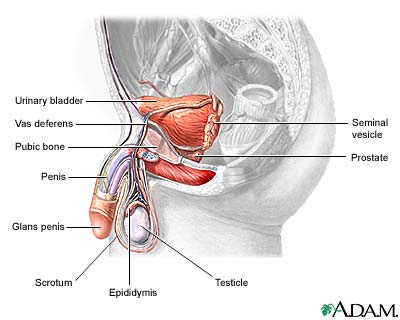
According to a somewhat more obscure modern re-reading of Quran 86:7, the functioning of two spinal cord centers located between vertebrae and ribs connecting spinal cord and sex organs, coupled with the nerves controlling valves around the urethra, together cause ejaculation. Those espousing this interpretation argue that a line drawn from the tip of the coccyx to the upper portion of either seminal vesicle and extended forward touches the ribcage. Thus, the seminal vesicles from which the semen spurts out, lie between the ribs and the coccyx (lower back, loin, backbone).
This reading takes the meaning of the verse to say that the impetus or nervous command for ejaculation comes from between the backbone and the ribs. Critics argue that the verse itself, however, only mentions a "liquid flowing" and does not refer to its cause which, along this logic, could very well be traced back to the brain itself. Moreover, critics rebut, the ribs are above the seminal vesicles which are above the tip of the coccyx when a standing person's anatomy is viewed. Only the top of the seminal vesicles falls between the bottom of the coccyx and the bottom of the rib-cage on the above mentioned line, the vesicle is not between the loins and ribs.[12] It is noted that, in addition to this, the role of the prostate glands (source of 25-30% of semen), testes (2-5%) and bulbourethral glands (up to 1%) is not considered in this analysis.
This modern interpretation then concludes with the following three ideas. Firstly, the word tara’ib refers to the woman’s uterus, since the rib cage surrounds it during pregnancy. Secondly, the verse refers to humans emerging from between the backbone and ribs, so it is about a baby and not sperm. And thirdly, the germ cells which later become sperms are formed near the backbone.
To the first of these ideas, critics respond that though the ribcage is roughly cylindrical, the uterus is never inside it. And the embryo is already "created" much before pregnancy since the verse refers to fertilization. The liquid being discussed here never flows anywhere close to a woman's ribs.
To the second of these ideas, critics argue that this is partly similar to the claim of tara'ib meaning uterus and that a baby does not emerge from within its mother's ribs, as should be obvious from the location of the 'baby bump' of a pregnant woman. The idea here is that if one were to describe the emergence of a baby by referring to external organs, one would have said "between backbone and abdomen", rather than ribs. Secondly, every classical tafsir and all major translations interpret Quran 86:7 (coming from between the backbone and the ribs) as a continuation from 86:6 ("He is created from a gushing fluid"), and so it is only a fluid that is said to emerge.
Critics find the third of these ideas to be straightforwardly false from a factual standpoint. They argue that the entire process of spermatogenesis from a spermatogonium to a sperm occurs in various regions of the testicles and not the "backbone".[13]
Overarching criticisms
Many, mutually exclusive interpretations
Critics often note that the many modern re-readings of Quran 86:7 are conflicting and mutually-exclusive, such that if any one is correct, the remainder must be incorrect. For instance, Ibn Kathir refers to tara’ib as a female organ, while other tafsirs claim it belongs to the man.[14] Another conflict is the definition of sulb to mean either the backbone, or the "hardening" of the man. To critics, these varying interpretations confirm the essential ambiguity of the scriptural texts.
The meaning of min bain
Another point alluded to by Dr. Campbell, is that the phrase min bain which literally means “from between”. If this interpretation is accepted, which seems to be the case from a reading of the commonly accepted translations, then one must also note that semen emanates from the penis, and not from between the penis and the vagina. To be strictly correct, semen emanates from the penis into the vagina. This point seems to rule out tara’ib from anything to do with the female sexual partner. His full response to claims of miracles in embryology and semen production can be read in the chapter 'Anatomy, Embryology and Genetics', pages 181-198 of his book, which can be read online for free following the link, The Quran and the Bible : in the light of history and science.
See Also
- Scientific Miracles in the Quran
- Scientific Errors in the Quran
- Scientific Errors in the Hadith
- Reproduction - A hub page that leads to other articles related to Reproduction
- Mistranslations of Islamic Scripture (English) - A hub page that leads to other articles related to Mistranslated Verses
External Links
- Science and Revelation: Anatomy, Embryology and Genetics
- Seminal Fluid From the Backbone: The Honest Truth - islamwhattheydonttellyou164 - YouTube Video
- Quran 86:6-7: Semen comes from between backbone and ribs. - The Islam Issue
References
- ↑ sulb - Lane's Lexicon page 1712
- ↑ 2.0 2.1 2.2 tara'ib - Lane's Lexicon page 301
- ↑ "Loin", Cambridge Dictionary
- ↑ thahr - Lane's Lexicon page 197
- ↑ Noble D, DiFrancesco D, Zancani D. Leonardo da Vinci and the origin of semen Notes and Records; Royal Society London Publishing. 2014 Dec 20; 68(4):391-402. doi: 10.1098/rsnr.2014.0021. PMID: 27494016; PMCID: PMC4213433.
- ↑ https://en.wiktionary.org/wiki/%D7%9E%D7%95%D7%97#Hebrew
- ↑ https://en.wiktionary.org/wiki/%D9%85%D8%AE#Arabic
- ↑ Hippocratic Writings (Penguin Classics, 1983) pp. 317-318
- ↑ genetics basics
- ↑ Embryology in the Qur'an Much Ado about Nothing
- ↑ See images here [1] [2] []
- ↑ For a visual reference, see this medical diagram. Taken from: "Reproductive Health Module (SECTION I: Reproductive Anatomy and Physiology)", Columbia University: Mailman School of Public Health, accessed March 22, 2014 (archived), http://www.columbia.edu/itc/hs/pubhealth/modules/reproductiveHealth/anatomy.html.
- ↑ Spermatogenesis
- ↑ "Sura Tariq (The Night) no.86 (verses 1-10)", Montazar.net, September 18, 2003 (archived), https://web.archive.org/web/20030918233810/http://www.montazar.net/eng/menu/1/quran/tafseer/tafseer-of-holy-quran/light/html/086/86_1-10.htm.
![[1]](https://en.wikipedia.org/wiki/File:Gray1156.png)
![[2]](https://en.wikipedia.org/wiki/File:Gray1136.png)