Mecca: Difference between revisions
| [checked revision] | [checked revision] |
Lightyears (talk | contribs) mNo edit summary |
Lightyears (talk | contribs) (Automated script replacing USC-MSA hadith numbering system for Bukhari, Muslim, and Abu Dawud) |
||
| (2 intermediate revisions by the same user not shown) | |||
| Line 42: | Line 42: | ||
The Becca problem could just be a scribal error. But then why was it not corrected before an authoritative text was issued? Furthermore, if the Quran is to be taken seriously as a source of historical knowledge, some explanation is required of why Abraham should have wanted to travel so far south from the Promised Land. Both problems could be solved by accepting that Becca is not Mecca, but somewhere further north. | The Becca problem could just be a scribal error. But then why was it not corrected before an authoritative text was issued? Furthermore, if the Quran is to be taken seriously as a source of historical knowledge, some explanation is required of why Abraham should have wanted to travel so far south from the Promised Land. Both problems could be solved by accepting that Becca is not Mecca, but somewhere further north. | ||
For advocates of a non-Hijazi origin, the only plausible solution to problems five and six, the fish eating farmers familiar with the cities of Lot, is to accept that some verses of the Qur’an were not written in either Mecca or Medina (which has an even lower rainfall than Mecca), or indeed anywhere in the Hijaz. To admit this undermines the project popular with scholars, of trying to explain the differences of style and doctrine to be found in the Qur’an by a sequential development in the career of its prophet. The problem is not simply a matter of determining the order in which verses were revealed, but where, when and by whom they were first written down<ref>More evidence for multiple authors is provided by Tommaso Tesei ''The Qurʾān(s) in Context(s)'' ''Journal Asiatique 309.2'' (2021) pp. 185-[https://www.academia.edu/75302962 202]</ref> | For advocates of a non-Hijazi origin, the only plausible solution to problems five and six, the fish eating farmers familiar with the cities of Lot, is to accept that some verses of the Qur’an were not written in either Mecca or Medina (which has an even lower rainfall than Mecca), or indeed anywhere in the Hijaz. To admit this undermines the project popular with scholars, of trying to explain the differences of style and doctrine to be found in the Qur’an by a sequential development in the career of its prophet. The problem is not simply a matter of determining the order in which verses were revealed, but where, when and by whom they were first written down.<ref>More evidence for multiple authors is provided by Tommaso Tesei ''The Qurʾān(s) in Context(s)'' ''Journal Asiatique 309.2'' (2021) pp. 185-[https://www.academia.edu/75302962 202]</ref> | ||
A useful overview of some of the main points in the academic debate on the Meccan origins of Islam is provided by Nicolai Sinai in chapter 3 of his book, ''The Qur'an: A Historical-Critical Introduction''.<ref name="Sinai2017">Nicolai Sinai, ''The Qur'an: A Historical-Critical Introduction'' Edinburgh University Press, 2017, Chapter 3: The Qur'anic Milieu</ref> | A useful overview of some of the main points in the academic debate on the Meccan origins of Islam is provided by Nicolai Sinai in chapter 3 of his book, ''The Qur'an: A Historical-Critical Introduction''.<ref name="Sinai2017">Nicolai Sinai, ''The Qur'an: A Historical-Critical Introduction'' Edinburgh University Press, 2017, Chapter 3: The Qur'anic Milieu</ref> | ||
| Line 60: | Line 60: | ||
Gibson argues that Petra is the more plausible candidate for the original Muslim shrine. It was an important trade centre, even if declining by the time of the Prophet. Agriculture was possible, including the cultivation of olives mentioned in the Quran. And it had an archbishop, thus a large Christian population, likely of an anti Trinitarian variety which is compatible with Islamic monotheism<ref>https://en.wikipedia.org/wiki/Petra, ‘''Climate''’ and ‘''Byzantine Period''’</ref>. Gibson offers various other arguments in favour of Petra, and Peter Townsend argues more generally for a north Arabian location<ref>''The Mecca Mystery'' (2018)</ref>. | Gibson argues that Petra is the more plausible candidate for the original Muslim shrine. It was an important trade centre, even if declining by the time of the Prophet. Agriculture was possible, including the cultivation of olives mentioned in the Quran. And it had an archbishop, thus a large Christian population, likely of an anti Trinitarian variety which is compatible with Islamic monotheism<ref>https://en.wikipedia.org/wiki/Petra, ‘''Climate''’ and ‘''Byzantine Period''’</ref>. Gibson offers various other arguments in favour of Petra, and Peter Townsend argues more generally for a north Arabian location<ref>''The Mecca Mystery'' (2018)</ref>. | ||
One specific point against Petra is that it is not near the Dead Sea and thus the cities of Lot, or not near enough | One specific point against Petra is that it is not near the Dead Sea and thus the cities of Lot, or not near enough, although if Mecca is the only competition for the original shrine, it is much nearer. If Petra contained a sanctuary, it is possible that it would have been visited by farmers from further north. Advocates of the theory argue that in any case, the Quran is inconsistent in a number of ways and that the best that can be hoped for is to get a partial match to what it suggests about its historical context. | ||
A general objection to the Petra hypothesis is that it is difficult to understand how the real birthplace of Islam could have been erased so completely from Muslim traditions<ref name="Sinai2017" /> | A general objection to the Petra hypothesis is that it is difficult to understand how the real birthplace of Islam could have been erased so completely from Muslim traditions.<ref name="Sinai2017" /> Advocates counter that there are numerous examples of partially successful attempts to rewrite history for political reasons. It is often noted that there is surprisingly little documentary evidence surviving from the first two centuries of Islam. Perhaps because the first Muslims were practical men more concerned with consolidating their new empire than writing about it. Or perhaps because by the second century a consensus had been reached about the value of the founding myth of Mecca, and all evidence to the contrary was destroyed. | ||
====Criticisms of Gibson==== | |||
==== | |||
David A. King, who is a leading academic scholar on the Qibla and early Arab astronomy, has written a number of articles fiercely criticising Gibson's work.<ref name="King2017">[https://muslimheritage.com/pibla-back-to-qibla/ From Petra back to Makka – From “Pibla” back to Qibla] by David King, 22 August 2017 on muslimheritage.com</ref><ref>[https://muslimheritage.com/the-petra-fallacy/ The Petra Fallacy: Early Mosques do face the Sacred Kaaba in Mecca] by David King, 15 September 2020 - muslimheritage.com</ref> The most fundamental problem with Gibson's hypothesis, argues King, is that Muslims did not apply mathematical geometry nor accurate coordinates for locations when determining the Qibla until the 9th century. He says that the first mathematical determination of the qibla known to us comes from Baghdad c. 825 CE. Even centuries after and despite such advances, it was common for Muslims to use a variety of non-mathematical, "folk astronomy" methods for determining the Qibla. | David A. King, who is a leading academic scholar on the Qibla and early Arab astronomy, has written a number of articles fiercely criticising Gibson's work.<ref name="King2017">[https://muslimheritage.com/pibla-back-to-qibla/ From Petra back to Makka – From “Pibla” back to Qibla] by David King, 22 August 2017 on muslimheritage.com</ref><ref>[https://muslimheritage.com/the-petra-fallacy/ The Petra Fallacy: Early Mosques do face the Sacred Kaaba in Mecca] by David King, 15 September 2020 - muslimheritage.com</ref> The most fundamental problem with Gibson's hypothesis, argues King, is that Muslims did not apply mathematical geometry nor accurate coordinates for locations when determining the Qibla until the 9th century. He says that the first mathematical determination of the qibla known to us comes from Baghdad c. 825 CE. Even centuries after and despite such advances, it was common for Muslims to use a variety of non-mathematical, "folk astronomy" methods for determining the Qibla. | ||
| Line 74: | Line 71: | ||
King argues that folk astronomy methods such as these would have been used also by the first generations since they had not yet encountered and embraced mathematical methods nor accurate location coordinates. The first generations in Iraq were said to have used the winter sunset direction (which accords with the Ka'bah-sector orientation method outlined above) and this is what some early mosques show, just as some early Egyptian mosques are aligned to winter sunrise. According to King, many other mosques cited by Gibson as evidence for his theory were in fact aligned based on the foundations of pre-Islamic edifices.<ref name="King2017" /> | King argues that folk astronomy methods such as these would have been used also by the first generations since they had not yet encountered and embraced mathematical methods nor accurate location coordinates. The first generations in Iraq were said to have used the winter sunset direction (which accords with the Ka'bah-sector orientation method outlined above) and this is what some early mosques show, just as some early Egyptian mosques are aligned to winter sunrise. According to King, many other mosques cited by Gibson as evidence for his theory were in fact aligned based on the foundations of pre-Islamic edifices.<ref name="King2017" /> | ||
King has | King has repeatedly emphasised that it is a basic fallacy even in principle to use exact individual directions or a statistical correlation of the sort asserted by Gibson to identify a specific directional intent on the part of early mosque builders, however strong or weak the correlation and the reliability of Gibson's underlying data may be (though King also questions Gibson's data). For centuries, those undisposed towards mathematical methods had only the very vaguest and often a highly inaccurate notion of the actual direction of Mecca, let alone anywhere else, and employed methods based on sacred geography, tradition, or roughly suitable pre-Islamic foundations that did not aspire in any way to accuracy. Gibson, recognising this problem, proposes various means by which the early mosque builders could have calculated accurate directions. However, these claims again receive scathing criticism from King.<ref name="King2017" /> | ||
While King critically engages with a large sample of Gibson's mosque datapoints,<ref name="King2017" /><ref>[https://www.researchgate.net/publication/330221815_King_The_Petra_fallacy_The_Petra_fallacy_-_Early_mosques_do_face_the_Sacred_Kaaba_in_Mecca_but_Dan_Gibson_doesn%27t_know_how_Comparing_historical_orientations_with_modern_directions_can_lead_to_false_re King: The Petra fallacy The Petra fallacy - Early mosques do face the Sacred Kaaba in Mecca but Dan Gibson doesn't know how / Comparing historical orientations with modern directions can lead to false results] - David King, December 2018</ref> another one discussed by Gibson is particularly interesting. The small mosque at the Humayma archaeological site in southern Jordan is located between Mecca and Petra, a mere 43km from the latter, yet its mihrab faces south towards Mecca, not towards Petra. Gibson claims without citing any evidence that it was built later than the next-door early 8th century Umayyad qasr (palace), which despite not being a mosque, Gibson also claims without evidence is intentionally oriented towards Petra.<ref>See [https://thesacredcity.ca/humeima.html Humeima Farm House] by Dan Gibson</ref> However, archaeologists have dated both the mosque and qasr to the same time in the early 8th century, supported by foundation pottery at both buildings as well as historical texts which mention the Abbasid family building a palace and mosque at that location during the Umayyad period.<ref>John Oleson and Rebecca Foote, [https://maxvanberchem.org/fr/activites-scientifiques/projets/archeologie/11-archeologie/54-humeima-excavation-project HUMEIMA EXCAVATION PROJECT, 1995-96] - Max van Berchem Foundation, Geneva, 1996</ref><ref>A photo of the mosque is available [http://jordanheritage.jo/wp-content/uploads/2018/08/%D8%A2%D8%AB%D8%A7%D8%B1-%D8%A7%D9%84%D8%AD%D9%85%D9%8A%D9%85%D8%A9-2-1024x676.jpg here]</ref> | While King critically engages with a large sample of Gibson's mosque datapoints,<ref name="King2017" /><ref>[https://www.researchgate.net/publication/330221815_King_The_Petra_fallacy_The_Petra_fallacy_-_Early_mosques_do_face_the_Sacred_Kaaba_in_Mecca_but_Dan_Gibson_doesn%27t_know_how_Comparing_historical_orientations_with_modern_directions_can_lead_to_false_re King: The Petra fallacy The Petra fallacy - Early mosques do face the Sacred Kaaba in Mecca but Dan Gibson doesn't know how / Comparing historical orientations with modern directions can lead to false results] - David King, December 2018</ref> another one discussed by Gibson is particularly interesting. The small mosque at the Humayma archaeological site in southern Jordan is located between Mecca and Petra, a mere 43km from the latter, yet its mihrab faces south towards Mecca, not towards Petra. Gibson claims without citing any evidence that it was built later than the next-door early 8th century Umayyad qasr (palace), which despite not being a mosque, Gibson also claims without evidence is intentionally oriented towards Petra.<ref>See [https://thesacredcity.ca/humeima.html Humeima Farm House] by Dan Gibson</ref> However, archaeologists have dated both the mosque and qasr to the same time in the early 8th century, supported by foundation pottery at both buildings as well as historical texts which mention the Abbasid family building a palace and mosque at that location during the Umayyad period.<ref>John Oleson and Rebecca Foote, [https://maxvanberchem.org/fr/activites-scientifiques/projets/archeologie/11-archeologie/54-humeima-excavation-project HUMEIMA EXCAVATION PROJECT, 1995-96] - Max van Berchem Foundation, Geneva, 1996</ref><ref>A photo of the mosque is available [http://jordanheritage.jo/wp-content/uploads/2018/08/%D8%A2%D8%AB%D8%A7%D8%B1-%D8%A7%D9%84%D8%AD%D9%85%D9%8A%D9%85%D8%A9-2-1024x676.jpg here]</ref> | ||
==Points | A significant linguistic problem with a Nabatean origin theory has been raised by Marijn van Putten, a leading academic scholar on early Arabic and in particular Quranic Arabic, who has argued in detail that the dialect evident in the Uthmanic rasm of the Quran is Old Hijazi and not Nabatean.<ref>Marijn van Putten, [https://brill.com/view/title/61587 Quranic Arabic: From its Hijazi origins to its classical reading traditions], Leiden: Brill, 2022 isbn: 9789004506251 (Open access pdf download, also available [https://www.academia.edu/71626921 here])<BR /> | ||
See especially pages 118, 120, 122, and footnote 32 on page 146.</ref> | |||
==Points supporting the traditional Meccan setting== | |||
Those who favour the traditional Meccan setting for Muhammad's early career as a prophet point out a very direct reference to Mecca in the Quran itself: | Those who favour the traditional Meccan setting for Muhammad's early career as a prophet point out a very direct reference to Mecca in the Quran itself: | ||
| Line 107: | Line 107: | ||
=== Hadith=== | === Hadith=== | ||
{{Quote|{{ | {{Quote|{{Bukhari|||3364|darussalam}}|Narrated Ibn `Abbas: | ||
The first lady to use a girdle was the mother of Ishmael. She used a girdle so that she might hide her tracks from Sarah. Abraham brought her and her son Ishmael while she was suckling him, to a place near the Ka`ba under a tree on the spot of Zamzam, at the highest place in the mosque. During those days there was nobody in Mecca, nor was there any water So he made them sit over there and placed near them a leather bag containing some dates, and a small water-skin containing some water, and set out homeward. Ishmael's mother followed him saying, "O Abraham! Where are you going, leaving us in this valley where there is no person whose company we may enjoy, nor is there anything (to enjoy)?" She repeated that to him many times, but he did not look back at her Then she asked him, "Has Allah ordered you to do so?" He said, "Yes." She said, "Then He will not neglect us," and returned while Abraham proceeded onwards, and on reaching the Thaniya where they could not see him, he faced the Ka`ba, and raising both hands, invoked Allah saying the following prayers: 'O our Lord! I have made some of my offspring dwell in a valley without cultivation, by Your Sacred House (Ka`ba at Mecca) in order, O our Lord, that they may offer prayer perfectly. So fill some hearts among men with love towards them, and (O Allah) provide them with fruits, so that they may give thanks.' (14.37) Ishmael's mother went on suckling Ishmael and drinking from the water (she had). When the water in the water-skin had all been used up, she became thirsty and her child also became thirsty. She started looking at him (i.e. Ishmael) tossing in agony; She left him, for she could not endure looking at him, and found that the mountain of Safa was the nearest mountain to her on that land. She stood on it and started looking at the valley keenly so that she might see somebody, but she could not see anybody. Then she descended from Safa and when she reached the valley, she tucked up her robe and ran in the valley like a person in distress and trouble, till she crossed the valley and reached the Marwa mountain where she stood and started looking, expecting to see somebody, but she could not see anybody. She repeated that (running between Safa and Marwa) seven times." The Prophet (ﷺ) said, "This is the source of the tradition of the walking of people between them (i.e. Safa and Marwa). When she reached the Marwa (for the last time) she heard a voice and she asked herself to be quiet and listened attentively. She heard the voice again and said, 'O, (whoever you may be)! You have made me hear your voice; have you got something to help me?" And behold! She saw an angel at the place of Zamzam, digging the earth with his heel (or his wing), till water flowed from that place. She started to make something like a basin around it, using her hand in this way, and started filling her water-skin with water with her hands, and the water was flowing out after she had scooped some of it." The Prophet (ﷺ) added, "May Allah bestow Mercy on Ishmael's mother! Had she let the Zamzam (flow without trying to control it) (or had she not scooped from that water) (to fill her water-skin), Zamzam would have been a stream flowing on the surface of the earth." The Prophet (ﷺ) further added, "Then she drank (water) and suckled her child. The angel said to her, 'Don't be afraid of being neglected, for this is the House of Allah which will be built by this boy and his father, and Allah never neglects His people.' The House (i.e. Ka`ba) at that time was on a high place resembling a hillock, and when torrents came, they flowed to its right and left. She lived in that way till some people from the tribe of Jurhum or a family from Jurhum passed by her and her child, as they (i.e. the Jurhum people) were coming through the way of Kada'. They landed in the lower part of Mecca where they saw a bird that had the habit of flying around water and not leaving it. They said, 'This bird must be flying around water, though we know that there is no water in this valley.' They sent one or two messengers who discovered the source of water, and returned to inform them of the water. So, they all came (towards the water)." The Prophet (ﷺ) added, "Ishmael's mother was sitting near the water. They asked her, 'Do you allow us to stay with you?" She replied, 'Yes, but you will have no right to possess the water.' They agreed to that." The Prophet (ﷺ) further said, "Ishmael's mother was pleased with the whole situation as she used to love to enjoy the company of the people. So, they settled there, and later on they sent for their families who came and settled with them so that some families became permanent residents there. The child (i.e. Ishmael) grew up and learnt Arabic from them and (his virtues) caused them to love and admire him as he grew up, and when he reached the age of puberty they made him marry a woman from amongst them. After Ishmael's mother had died, Abraham came after Ishmael's marriage in order to see his family that he had left before, but he did not find Ishmael there. When he asked Ishmael's wife about him, she replied, 'He has gone in search of our livelihood.' Then he asked her about their way of living and their condition, and she replied, 'We are living in misery; we are living in hardship and destitution,' complaining to him. He said, 'When your husband returns, convey my salutation to him and tell him to change the threshold of the gate (of his house).' When Ishmael came, he seemed to have felt something unusual, so he asked his wife, 'Has anyone visited you?' She replied, 'Yes, an old man of so-and-so description came and asked me about you and I informed him, and he asked about our state of living, and I told him that we were living in a hardship and poverty.' On that Ishmael said, 'Did he advise you anything?' She replied, 'Yes, he told me to convey his salutation to you and to tell you to change the threshold of your gate.' Ishmael said, 'It was my father, and he has ordered me to divorce you. Go back to your family.' So, Ishmael divorced her and married another woman from amongst them (i.e. Jurhum). Then Abraham stayed away from them for a period as long as Allah wished and called on them again but did not find Ishmael. So he came to Ishmael's wife and asked her about Ishmael. She said, 'He has gone in search of our livelihood.' Abraham asked her, 'How are you getting on?' asking her about their sustenance and living. She replied, 'We are prosperous and well-off (i.e. we have everything in abundance).' <b>Then she thanked Allah' Abraham said, 'What kind of food do you eat?' She said. 'Meat.' He said, 'What do you drink?' She said, 'Water." He said, "O Allah! Bless their meat and water." The Prophet added, "At that time they did not have grain, and if they had grain, he would have also invoked Allah to bless it." The Prophet (ﷺ) added, "If somebody has only these two things as his sustenance, his health and disposition will be badly affected, unless he lives in Mecca."</b> The Prophet (ﷺ) added," Then Abraham said Ishmael's wife, "When your husband comes, give my regards to him and tell him that he should keep firm the threshold of his gate.' When Ishmael came back, he asked his wife, 'Did anyone call on you?' She replied, 'Yes, a good-looking old man came to me,' so she praised him and added. 'He asked about you, and I informed him, and he asked about our livelihood and I told him that we were in a good condition.' Ishmael asked her, 'Did he give you any piece of advice?' She said, 'Yes, he told me to give his regards to you and ordered that you should keep firm the threshold of your gate.' On that Ishmael said, 'It was my father, and you are the threshold (of the gate). He has ordered me to keep you with me.' Then Abraham stayed away from them for a period as long as Allah wished, and called on them afterwards. He saw Ishmael under a tree near Zamzam, sharpening his arrows. When he saw Abraham, he rose up to welcome him (and they greeted each other as a father does with his son or a son does with his father). Abraham said, 'O Ishmael! Allah has given me an order.' Ishmael said, 'Do what your Lord has ordered you to do.' Abraham asked, 'Will you help me?' Ishmael said, 'I will help you.' Abraham said, Allah has ordered me to build a house here,' pointing to a hillock higher than the land surrounding it." The Prophet (ﷺ) added, "Then they raised the foundations of the House (i.e. the Ka`ba). Ishmael brought the stones and Abraham was building, and when the walls became high, Ishmael brought this stone and put it for Abraham who stood over it and carried on building, while Ishmael was handing him the stones, and both of them were saying, 'O our Lord! Accept (this service) from us, Verily, You are the All-Hearing, the All-Knowing.' The Prophet (ﷺ) added, "Then both of them went on building and going round the Ka`ba saying: O our Lord ! Accept (this service) from us, Verily, You are the All-Hearing, the All-Knowing." (2.127)}} | The first lady to use a girdle was the mother of Ishmael. She used a girdle so that she might hide her tracks from Sarah. Abraham brought her and her son Ishmael while she was suckling him, to a place near the Ka`ba under a tree on the spot of Zamzam, at the highest place in the mosque. During those days there was nobody in Mecca, nor was there any water So he made them sit over there and placed near them a leather bag containing some dates, and a small water-skin containing some water, and set out homeward. Ishmael's mother followed him saying, "O Abraham! Where are you going, leaving us in this valley where there is no person whose company we may enjoy, nor is there anything (to enjoy)?" She repeated that to him many times, but he did not look back at her Then she asked him, "Has Allah ordered you to do so?" He said, "Yes." She said, "Then He will not neglect us," and returned while Abraham proceeded onwards, and on reaching the Thaniya where they could not see him, he faced the Ka`ba, and raising both hands, invoked Allah saying the following prayers: 'O our Lord! I have made some of my offspring dwell in a valley without cultivation, by Your Sacred House (Ka`ba at Mecca) in order, O our Lord, that they may offer prayer perfectly. So fill some hearts among men with love towards them, and (O Allah) provide them with fruits, so that they may give thanks.' (14.37) Ishmael's mother went on suckling Ishmael and drinking from the water (she had). When the water in the water-skin had all been used up, she became thirsty and her child also became thirsty. She started looking at him (i.e. Ishmael) tossing in agony; She left him, for she could not endure looking at him, and found that the mountain of Safa was the nearest mountain to her on that land. She stood on it and started looking at the valley keenly so that she might see somebody, but she could not see anybody. Then she descended from Safa and when she reached the valley, she tucked up her robe and ran in the valley like a person in distress and trouble, till she crossed the valley and reached the Marwa mountain where she stood and started looking, expecting to see somebody, but she could not see anybody. She repeated that (running between Safa and Marwa) seven times." The Prophet (ﷺ) said, "This is the source of the tradition of the walking of people between them (i.e. Safa and Marwa). When she reached the Marwa (for the last time) she heard a voice and she asked herself to be quiet and listened attentively. She heard the voice again and said, 'O, (whoever you may be)! You have made me hear your voice; have you got something to help me?" And behold! She saw an angel at the place of Zamzam, digging the earth with his heel (or his wing), till water flowed from that place. She started to make something like a basin around it, using her hand in this way, and started filling her water-skin with water with her hands, and the water was flowing out after she had scooped some of it." The Prophet (ﷺ) added, "May Allah bestow Mercy on Ishmael's mother! Had she let the Zamzam (flow without trying to control it) (or had she not scooped from that water) (to fill her water-skin), Zamzam would have been a stream flowing on the surface of the earth." The Prophet (ﷺ) further added, "Then she drank (water) and suckled her child. The angel said to her, 'Don't be afraid of being neglected, for this is the House of Allah which will be built by this boy and his father, and Allah never neglects His people.' The House (i.e. Ka`ba) at that time was on a high place resembling a hillock, and when torrents came, they flowed to its right and left. She lived in that way till some people from the tribe of Jurhum or a family from Jurhum passed by her and her child, as they (i.e. the Jurhum people) were coming through the way of Kada'. They landed in the lower part of Mecca where they saw a bird that had the habit of flying around water and not leaving it. They said, 'This bird must be flying around water, though we know that there is no water in this valley.' They sent one or two messengers who discovered the source of water, and returned to inform them of the water. So, they all came (towards the water)." The Prophet (ﷺ) added, "Ishmael's mother was sitting near the water. They asked her, 'Do you allow us to stay with you?" She replied, 'Yes, but you will have no right to possess the water.' They agreed to that." The Prophet (ﷺ) further said, "Ishmael's mother was pleased with the whole situation as she used to love to enjoy the company of the people. So, they settled there, and later on they sent for their families who came and settled with them so that some families became permanent residents there. The child (i.e. Ishmael) grew up and learnt Arabic from them and (his virtues) caused them to love and admire him as he grew up, and when he reached the age of puberty they made him marry a woman from amongst them. After Ishmael's mother had died, Abraham came after Ishmael's marriage in order to see his family that he had left before, but he did not find Ishmael there. When he asked Ishmael's wife about him, she replied, 'He has gone in search of our livelihood.' Then he asked her about their way of living and their condition, and she replied, 'We are living in misery; we are living in hardship and destitution,' complaining to him. He said, 'When your husband returns, convey my salutation to him and tell him to change the threshold of the gate (of his house).' When Ishmael came, he seemed to have felt something unusual, so he asked his wife, 'Has anyone visited you?' She replied, 'Yes, an old man of so-and-so description came and asked me about you and I informed him, and he asked about our state of living, and I told him that we were living in a hardship and poverty.' On that Ishmael said, 'Did he advise you anything?' She replied, 'Yes, he told me to convey his salutation to you and to tell you to change the threshold of your gate.' Ishmael said, 'It was my father, and he has ordered me to divorce you. Go back to your family.' So, Ishmael divorced her and married another woman from amongst them (i.e. Jurhum). Then Abraham stayed away from them for a period as long as Allah wished and called on them again but did not find Ishmael. So he came to Ishmael's wife and asked her about Ishmael. She said, 'He has gone in search of our livelihood.' Abraham asked her, 'How are you getting on?' asking her about their sustenance and living. She replied, 'We are prosperous and well-off (i.e. we have everything in abundance).' <b>Then she thanked Allah' Abraham said, 'What kind of food do you eat?' She said. 'Meat.' He said, 'What do you drink?' She said, 'Water." He said, "O Allah! Bless their meat and water." The Prophet added, "At that time they did not have grain, and if they had grain, he would have also invoked Allah to bless it." The Prophet (ﷺ) added, "If somebody has only these two things as his sustenance, his health and disposition will be badly affected, unless he lives in Mecca."</b> The Prophet (ﷺ) added," Then Abraham said Ishmael's wife, "When your husband comes, give my regards to him and tell him that he should keep firm the threshold of his gate.' When Ishmael came back, he asked his wife, 'Did anyone call on you?' She replied, 'Yes, a good-looking old man came to me,' so she praised him and added. 'He asked about you, and I informed him, and he asked about our livelihood and I told him that we were in a good condition.' Ishmael asked her, 'Did he give you any piece of advice?' She said, 'Yes, he told me to give his regards to you and ordered that you should keep firm the threshold of your gate.' On that Ishmael said, 'It was my father, and you are the threshold (of the gate). He has ordered me to keep you with me.' Then Abraham stayed away from them for a period as long as Allah wished, and called on them afterwards. He saw Ishmael under a tree near Zamzam, sharpening his arrows. When he saw Abraham, he rose up to welcome him (and they greeted each other as a father does with his son or a son does with his father). Abraham said, 'O Ishmael! Allah has given me an order.' Ishmael said, 'Do what your Lord has ordered you to do.' Abraham asked, 'Will you help me?' Ishmael said, 'I will help you.' Abraham said, Allah has ordered me to build a house here,' pointing to a hillock higher than the land surrounding it." The Prophet (ﷺ) added, "Then they raised the foundations of the House (i.e. the Ka`ba). Ishmael brought the stones and Abraham was building, and when the walls became high, Ishmael brought this stone and put it for Abraham who stood over it and carried on building, while Ishmael was handing him the stones, and both of them were saying, 'O our Lord! Accept (this service) from us, Verily, You are the All-Hearing, the All-Knowing.' The Prophet (ﷺ) added, "Then both of them went on building and going round the Ka`ba saying: O our Lord ! Accept (this service) from us, Verily, You are the All-Hearing, the All-Knowing." (2.127)}} | ||
Latest revision as of 20:28, 12 November 2025
Error creating thumbnail: Unable to save thumbnail to destination
| This article or section is being renovated. Lead = 2 / 4
Structure = 3 / 4
Content = 3 / 4
Language = 4 / 4
References = 3 / 4
|
Mecca, also known as Makkah al-Mukarramah (مكة المكرمة, lit. "the Blessed Mecca"), is a city located in the Hijaz region of the Arabian Peninsula and is described by Islamic scriptures as the birthplace of Muhammad (b. 570), the founder of Islam. Mecca is host to the Kaaba, the holiest Islamic mosque (and central pagan shrine prior to Muhammad's conquest of Mecca), and thus the site of the annual Islamic pilgrimage called the Hajj which physically and financially able Muslims are required to attend at least once in their lifetimes (one of the Five Pillars of Islam). Practicing Muslims face Mecca as they pray towards the Kaaba (their qibla, or direction of prayer) five times a day (another one of the Five Pillars of Islam).
It is said that upon his conquest of Mecca, the prophet Muhammad received revelation that prohibited non-Muslims (which the revelation describes as najas, or "filthy") from entering the city. This law remains in effect until today.
According to Islamic scriptures
Almost a decade after claiming prophet-hood in Mecca in 610, Muhammad was forced to flee to Medina in 622 after facing prosecution for insulting and criticizing the gods and beliefs of the Meccan pagans. Ultimately, after erecting the Islamic state from his base in Medina, Muhammad was able to return to Mecca, this time as conqueror, in 630. Since Muhammad's death in 632, political leadership of Mecca, the holiest city in Islam, as well as Medina, the second holiest city in Islam, has been a significant basis for political claims of authority.
In the Qur'an, the city is also referred to as "Bakkah" as well as "Umm al-Qura" (lit. "mother of all settlements"). The city is described in Islamic scriptures as having been founded by Abraham as he constructed the Kaaba with his son Ishmael (Ismail), though there is an absence of any archaeological evidence to support this narrative.
Islamic texts further maintain that Mecca was the trade capital of the Hijaz and Arabia at large, though even this lacks an archaeological basis.
Early history and modern controversy as to the birthplace of Islam
Traditionally, Mecca is assumed to be the birthplace of Islam. Starting with Abraham, who founded Al-Masjid-al-Haram, the Mosque of the sanctuary, or Holy Shrine, which encloses, or possibly is, the Ka’bah, or Cube, which holds the Black Stone. The holiness of this sanctuary was confirmed by the prophet Muhammad, who was born and worked in Mecca, and started his preaching career in the city.
Very little is known through archaeological and historically relied-upon channels about the early and pre-Islamic history of Mecca, as the city is neither referred to unambiguously by any document prior to the rise of Islam, nor is there any architecture in Mecca that has been determined to have persisted from the life of Muhammad at the beginning of the seventh century.[1] Indeed, even while contemporary Romans produced detailed descriptions of Arabia at large and Western Arabia (the Hijaz) in particular, no references can be found to anything that could be described as a pilgrimage or trade centre at Mecca.
A place called Macoraba in Arabia is mentioned in a geographic work by Ptolemy in the 2nd century CE. Many academic scholars believe this is a reference to Mecca (first proposed in the 16th century), and some even think that the name derives from an ancient South Arabian word for temple, mkrb. Other historians such as Patricia Crone and Ian D. Morris have argued that there is no good reason to believe Macoraba and Mecca are the same place. The idea has never been backed by any significant academic investigation, nor has any other ancient source been shown to describe Mecca or its temple.[2]
Historian Patricia Crone is widely considered to have established that Mecca was of no wider importance at the time of Islam's emergence, was not on the major trade route, and traded in goods like leather, wool and other pastoral products.[3] She also pointed out that the audience of the supposedly Meccan verses of the Qur'an are prosperous farmers who have an interest in the sea and ate fish, activities difficult in the arid wastes around Mecca[4].
In sum, the problems with Mecca are
1. No mention in ancient sources.
2. Not on ancient trade routes.
3. No archaeological remains, in spite of extensive excavations for new buildings.
4. The Abrahamic sanctuary is located by the Quran in Becca/Bakkah rather than Mecca/Makkah (Quran 3:96).
5. Its climate is not compatible with the address of the supposedly Meccan verses of the Quran to prosperous fish eating farmers.
6. Who are said to pass day and night by the remains of Lot's people (Quran 37:133-138, Quran 11:89). Traditionally this is interpreted as a trade route, since Quran 15:76 states that the punishment of Lot's people can be found on "an established road". Sodom and Gomorrah were traditionally somewhere near the Dead Sea.
7. There is a rock inscription near Mecca which dates the building of Al-Masjid-al-Haram to 78 AH / 697-698 CE[5].
The first three points only tell against traditional descriptions of Mecca as a bustling centre of trade. They are compatible with the existence of a sanctuary patronised by local tribes. But this raises the difficulty of the absence of Christians in the area, given that the Quran is so heavily influenced by Christianity.
Problem seven about the inscription can be dismissed by the claim that the Arabic word translated as ‘built’ also means ‘rebuilt’[6]. It should be noted however that this is compatible with the hypothesis that while there was a local sanctuary at Mecca, it became the Holy Mosque only in 78 AH.
The Becca problem could just be a scribal error. But then why was it not corrected before an authoritative text was issued? Furthermore, if the Quran is to be taken seriously as a source of historical knowledge, some explanation is required of why Abraham should have wanted to travel so far south from the Promised Land. Both problems could be solved by accepting that Becca is not Mecca, but somewhere further north.
For advocates of a non-Hijazi origin, the only plausible solution to problems five and six, the fish eating farmers familiar with the cities of Lot, is to accept that some verses of the Qur’an were not written in either Mecca or Medina (which has an even lower rainfall than Mecca), or indeed anywhere in the Hijaz. To admit this undermines the project popular with scholars, of trying to explain the differences of style and doctrine to be found in the Qur’an by a sequential development in the career of its prophet. The problem is not simply a matter of determining the order in which verses were revealed, but where, when and by whom they were first written down.[7]
A useful overview of some of the main points in the academic debate on the Meccan origins of Islam is provided by Nicolai Sinai in chapter 3 of his book, The Qur'an: A Historical-Critical Introduction.[8]
Palestine as a possible location
Stephen Shoemaker and Guillaume Dye have both suggested Palestine as an alternative possible origin for at least part of the Quran. Shoemaker has argued for a connection between the Quranic nativity story (Quran 19:16) and the Kathisma Church in Palestine (see Parallels Between the Qur'an and Late Antique Judeo-Christian Literature),[9] while Dye has argued for a connection with the same church and another element of Surah Maryam, the reference to Mary as "Sister of Aaron" (verse 28; see the discussion in the article Mary, Sister of Aaron).[10]
Gibson's Petra theory
In 2011, independent scholar Dan Gibson first proposed his theory that Islam originated not in Mecca, but in Petra, the ancient Nabatean city in modern-day Jordan.[11] He was motivated, among other factors, because geographical descriptions provided of Mecca in Islamic scriptures fail to map reliably onto the geography of the actual city of Mecca, and because in his opinion, ample archaeological evidence demonstrates that for roughly a century after Muhammad's death Muslim prayed toward Petra as their qibla.[12] This interpretation collides heavily with the explicit statements of Islamic scriptures and, advocates claim, conforms more readily with Islamic scriptures' implicit, geographical descriptions of Mecca, as well as with the archaeological evidence available to us today.
Gibson's theory has a considerable following online, though has not met with acceptance in wider academic circles. Professor Sean Anthony, a renowned historian of Islam, has remarked that no scholars take the Petra origin theory seriously.[13] Similarly, David King, who is a longstanding critic of Gibson, writes that "His claims about Petra as the cradle of Islam are not taken seriously by scholars of Nabataean Studies."[14]
Dan Gibson[15] has provided both an alternative to the Mecca hypothesis and new evidence, by measuring the orientations of early mosques in terms of the prayer niche, or mihrab, indicating the direction of prayer. The Quran orders Muslims to face the Holy Mosque (Quran 2:144), and the accepted interpretation is that they must face Mecca when praying[16]. As an aid, mosques are built facing Mecca. Which is to say, the prayer wall is built perpendicular to a straight line to Mecca, and worshippers face this wall. The question then is in which direction are early mosques orientated? And if not to Mecca, when did it change?
Gibson claims to have found that the earliest mosques face Petra rather than Mecca, but there was a gradual reorientation to Mecca over a period of centuries. He suggests that the original Holy Mosque of Islam was at Petra, but was then changed to Mecca for political reasons, presumably encouraged by earthquakes at Petra.
Gibson argues that Petra is the more plausible candidate for the original Muslim shrine. It was an important trade centre, even if declining by the time of the Prophet. Agriculture was possible, including the cultivation of olives mentioned in the Quran. And it had an archbishop, thus a large Christian population, likely of an anti Trinitarian variety which is compatible with Islamic monotheism[17]. Gibson offers various other arguments in favour of Petra, and Peter Townsend argues more generally for a north Arabian location[18].
One specific point against Petra is that it is not near the Dead Sea and thus the cities of Lot, or not near enough, although if Mecca is the only competition for the original shrine, it is much nearer. If Petra contained a sanctuary, it is possible that it would have been visited by farmers from further north. Advocates of the theory argue that in any case, the Quran is inconsistent in a number of ways and that the best that can be hoped for is to get a partial match to what it suggests about its historical context.
A general objection to the Petra hypothesis is that it is difficult to understand how the real birthplace of Islam could have been erased so completely from Muslim traditions.[8] Advocates counter that there are numerous examples of partially successful attempts to rewrite history for political reasons. It is often noted that there is surprisingly little documentary evidence surviving from the first two centuries of Islam. Perhaps because the first Muslims were practical men more concerned with consolidating their new empire than writing about it. Or perhaps because by the second century a consensus had been reached about the value of the founding myth of Mecca, and all evidence to the contrary was destroyed.
Criticisms of Gibson
David A. King, who is a leading academic scholar on the Qibla and early Arab astronomy, has written a number of articles fiercely criticising Gibson's work.[19][20] The most fundamental problem with Gibson's hypothesis, argues King, is that Muslims did not apply mathematical geometry nor accurate coordinates for locations when determining the Qibla until the 9th century. He says that the first mathematical determination of the qibla known to us comes from Baghdad c. 825 CE. Even centuries after and despite such advances, it was common for Muslims to use a variety of non-mathematical, "folk astronomy" methods for determining the Qibla.
King discusses in one of his articles medieval examples of such methods illustrated in texts from the 9th century onwards. These divided the world into 4, 8, or later even more sectors, arranged around the sides of the Ka'bah, which itself was known even by medieval scholars to be aligned astronomically; its minor axis being aligned with summer sunrise/winter sunset and its major axis with the rising or setting of Canopus and Ursa Major. King writes, "Each sector is associated with a segment of the perimeter of the Kaʿba and the qibla in each sector is the direction in which one stands in front of the Kaʿba facing that segment of its perimeter"[21] Such texts advised Muslims to orient themselves towards the specified direction for their sector/location by observing the setting or rising direction of the sun on the winter or summer solstices, or the direction in which certain stars appear, or even the "four winds". In some cases cardinal directions were preferred. In particular, at a number of locations including Medina, Mecca was considered due south.
King argues that folk astronomy methods such as these would have been used also by the first generations since they had not yet encountered and embraced mathematical methods nor accurate location coordinates. The first generations in Iraq were said to have used the winter sunset direction (which accords with the Ka'bah-sector orientation method outlined above) and this is what some early mosques show, just as some early Egyptian mosques are aligned to winter sunrise. According to King, many other mosques cited by Gibson as evidence for his theory were in fact aligned based on the foundations of pre-Islamic edifices.[19]
King has repeatedly emphasised that it is a basic fallacy even in principle to use exact individual directions or a statistical correlation of the sort asserted by Gibson to identify a specific directional intent on the part of early mosque builders, however strong or weak the correlation and the reliability of Gibson's underlying data may be (though King also questions Gibson's data). For centuries, those undisposed towards mathematical methods had only the very vaguest and often a highly inaccurate notion of the actual direction of Mecca, let alone anywhere else, and employed methods based on sacred geography, tradition, or roughly suitable pre-Islamic foundations that did not aspire in any way to accuracy. Gibson, recognising this problem, proposes various means by which the early mosque builders could have calculated accurate directions. However, these claims again receive scathing criticism from King.[19]
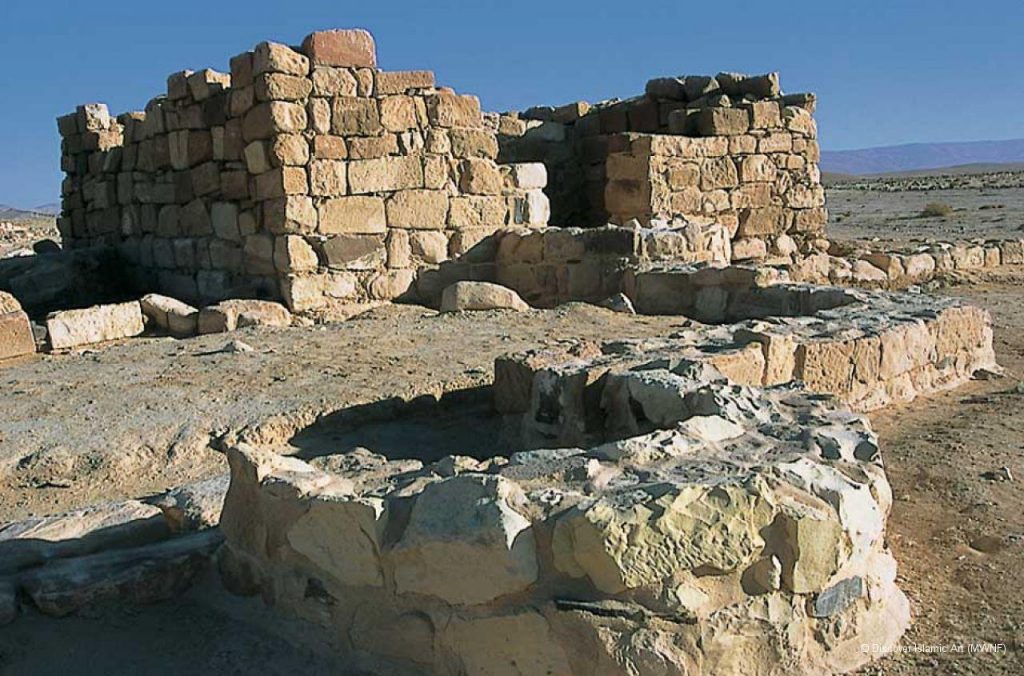
While King critically engages with a large sample of Gibson's mosque datapoints,[19][22] another one discussed by Gibson is particularly interesting. The small mosque at the Humayma archaeological site in southern Jordan is located between Mecca and Petra, a mere 43km from the latter, yet its mihrab faces south towards Mecca, not towards Petra. Gibson claims without citing any evidence that it was built later than the next-door early 8th century Umayyad qasr (palace), which despite not being a mosque, Gibson also claims without evidence is intentionally oriented towards Petra.[23] However, archaeologists have dated both the mosque and qasr to the same time in the early 8th century, supported by foundation pottery at both buildings as well as historical texts which mention the Abbasid family building a palace and mosque at that location during the Umayyad period.[24][25]
A significant linguistic problem with a Nabatean origin theory has been raised by Marijn van Putten, a leading academic scholar on early Arabic and in particular Quranic Arabic, who has argued in detail that the dialect evident in the Uthmanic rasm of the Quran is Old Hijazi and not Nabatean.[26]
Points supporting the traditional Meccan setting
Those who favour the traditional Meccan setting for Muhammad's early career as a prophet point out a very direct reference to Mecca in the Quran itself:
They are the ones who disbelieved and obstructed you from al-Masjid al-Haram while the offering was prevented from reaching its place of sacrifice. And if not for believing men and believing women whom you did not know - that you might trample them and there would befall you because of them dishonor without [your] knowledge - [you would have been permitted to enter Makkah]. [This was so] that Allah might admit to His mercy whom He willed. If they had been apart [from them], We would have punished those who disbelieved among them with painful punishment
Similarly, some point to another verse which accurately describes the Ka'bah as being sited near an uncultivated valley:
Various other identifiable locations are mentioned in the Quran in the wider region, but most notably Yathrib in Quran 33:13. That Yathrib is the same as al-Medina is verified in the mid 7th century Syriac Khuzistan Chronicle. In addition, the Constitution of Medina (between "the believers and submitters of Quraysh and Yathrib") is generally considered authentic.[8] A migration after being driven out from the sacred precinct is alluded to in various verses of the Quran. Nicolai Sinai has noted a number of other useful observations, particularly that certain cultic practices alluded to in the Quran would more likely be found deep in the Arabian peninsula than its northern periphery. [8] Regarding the religious environment suggested by the Quran, Sinai further points out that a ninth century CE Islamic source mentions a Christian cemetery in Mecca, while other vestiges in Islamic sources permit the positing of a limited Christian presence in the Hijaz (which is also supported by rock inscriptions - see Pre-Islamic Arab Religion in Islam regarding Christian inscriptions as well as regarding the distinctively Quranic spelling of Allah found in inscriptions between Mecca and Ta'if).
Regarding agricultural references in the Quran it is sometimes pointed out that Yāqūt al-Hamawī (d. 1229 CE) in his great work on geography describes Mecca as follows:
There is no flowing water in Mecca, for its water falls from the sky. They have no wells suitable for drinking; the best of them is zamzam, and it cannot be drunk from continuously. There are no fruit-bearing trees in the entirety of Mecca other than desert trees. However, once one passes the limits of the sacred precinct (haram), there are many wells, springs and walled gardens and wadis with greenery, farms and palm groves, though within the sacred precinct there are no fruit-bearing trees other than a few scattered date palms.
Relevant Quotations
Qur'an
They are the ones who disbelieved and obstructed you from al-Masjid al-Haram while the offering was prevented from reaching its place of sacrifice. And if not for believing men and believing women whom you did not know - that you might trample them and there would befall you because of them dishonor without [your] knowledge - [you would have been permitted to enter Makkah]. [This was so] that Allah might admit to His mercy whom He willed. If they had been apart [from them], We would have punished those who disbelieved among them with painful punishment
96. Lo! the first Sanctuary appointed for mankind was that at Becca, a blessed place, a guidance to the peoples;
97. Wherein are plain memorials (of Allah's guidance); the place where Abraham stood up to pray; and whosoever entereth it is safe. And pilgrimage to the House is a duty unto Allah for mankind, for him who can find a way thither. As for him who disbelieveth, (let him know that) lo! Allah is Independent of (all) creatures.Hadith
See Also
References
- ↑ Robert Schick, Archaeology and the Quran, Encyclopaedia of the Qur'an
- ↑ See the conclusion in Ian D. Morris (2018) Mecca and Macoraba in: al-Usur al-wusta vol. 26 (2018)
- ↑ This was definitively argued by Crone in her 1987 book Meccan Trade and the Rise of Islam, and further defended and refined in her 1992 article Serjeant and Meccan Trade and her 2007 article Quraysh and the Roman Army: Making Sense of the Meccan Leather Trade
- ↑ As pointed out by Patricia Crone, How Did the Quranic Pagans Make a Living? Bulletin of the School of Oriental and African Studies, University of London, Vol. 68, No. 3 (2005), pp. 387-399. Available at http://www.jstor.org/stable/[1], also in her Collected Studies(2016).
- ↑ www.islamic-awareness.org/history/islam/inscriptions/haram1
- ↑ https://archive.org/details/MedievalJerusalemAndIslamicWorshipHolyPlacesCeremoniesPilgrimageIslamicHistoryAndCivilization p.39.
- ↑ More evidence for multiple authors is provided by Tommaso Tesei The Qurʾān(s) in Context(s) Journal Asiatique 309.2 (2021) pp. 185-202
- ↑ 8.0 8.1 8.2 8.3 Nicolai Sinai, The Qur'an: A Historical-Critical Introduction Edinburgh University Press, 2017, Chapter 3: The Qur'anic Milieu
- ↑ Stephen Shoemaker, Christmas in the Qur’an: the Qur’anic Account of Jesus’ Nativity and Palestinian Local Tradition Jerusalem Studies in Arabic and Islam 28, 11-39 (2003) pp. 19-21
- ↑ Guillaume Dye, “The Qur’ān and its Hypertextuality in Light of Redaction Criticism,” The Fourth Nangeroni Meeting Early Islam: The Sectarian Milieu of Late Antiquity? (Early Islamic Studies Seminar, Milan) (15-19 June 2015): 10
- ↑ Dan Gibson, Qur'ānic Geography: A survey and evaluation of the geographical references in the Qur'ān with suggested solutions for various problems and issues., Vancouver: Independent Scholar's Press, 2011
- ↑ Numerous videos by Dan Gibson arguing for the Petra hypothesis are available on YouTube, and there is a recent summary of the evidence at nabataea.net.
- ↑ Ask Me Anything comment by Sean Anthony - AcademicQuran board on reddit.com, 27 May 2023
- ↑ See "Notes added in September 2020" in the article The Petra Fallacy: Early Mosques do face the Sacred Kaaba in Mecca by David King, 15 September 2020 - muslimheritage.com
- ↑ Most recently in Let the Stones Speak
- ↑ As Ohlig points out, praying is not in the original Arabic, but is added by all translators except Arberry. See From Muhammad Jesus to the Prophet of the Arabs, section 6.5 The direction of prayer (Qibla), pp 300 to 304, in Karl-Heinz Ohlig ed. Early Islam (2013). Available at archive.org. For a literal translation see https://quranwbw.com/2
- ↑ https://en.wikipedia.org/wiki/Petra, ‘Climate’ and ‘Byzantine Period’
- ↑ The Mecca Mystery (2018)
- ↑ 19.0 19.1 19.2 19.3 From Petra back to Makka – From “Pibla” back to Qibla by David King, 22 August 2017 on muslimheritage.com
- ↑ The Petra Fallacy: Early Mosques do face the Sacred Kaaba in Mecca by David King, 15 September 2020 - muslimheritage.com
- ↑ Islamic sacred geography for finding the qibla by the sun and stars: A survey of the historical sources by David King, 2019
- ↑ King: The Petra fallacy The Petra fallacy - Early mosques do face the Sacred Kaaba in Mecca but Dan Gibson doesn't know how / Comparing historical orientations with modern directions can lead to false results - David King, December 2018
- ↑ See Humeima Farm House by Dan Gibson
- ↑ John Oleson and Rebecca Foote, HUMEIMA EXCAVATION PROJECT, 1995-96 - Max van Berchem Foundation, Geneva, 1996
- ↑ A photo of the mosque is available here
- ↑ Marijn van Putten, Quranic Arabic: From its Hijazi origins to its classical reading traditions, Leiden: Brill, 2022 isbn: 9789004506251 (Open access pdf download, also available here)
See especially pages 118, 120, 122, and footnote 32 on page 146.